Tattoo Guide/how to prepare
How do you prepare a brief before a tattoo appointment?
You have had the idea for months, you walk into the studio, and then you start scrolling through 200 screenshots looking for the right one. Meanwhile the artist is trying to guess the size, the placement and your budget from three references that contradict each other. That appointment can go very differently: one page, six answers, and the conversation starts on the drawing instead of the questionnaire.
6 min read · Updated Sep 2026
Want placement, size, budget and constraints on one page to show at your appointment?
Create my tattoo briefQuick answer
A tattoo artist needs six things: the placement, the size in centimetres, the style, one or two visual references, your budget and your constraints (scar, cover-up, deadline). Put them on a single page before the appointment. Present your images as intent rather than a drawing to reproduce: that is what separates a prepared client from one who dictates.
Key takeaways
- 01Six pieces of information are enough: placement, size in cm, style, references, budget, constraints
- 02Size in centimetres is the most commonly missing detail, and the one that drives both price and how much detail can survive
- 03Two or three references beat twenty: past that, your message contradicts itself
- 04An AI-generated image is a reference for intent, never a drawing to copy
- 05Sharing a budget range is not rude, it saves everyone time
The brief you hand over
TryTattoo designsOne page: the design you picked, the variations you considered, the specs, what you care about and your budget range.
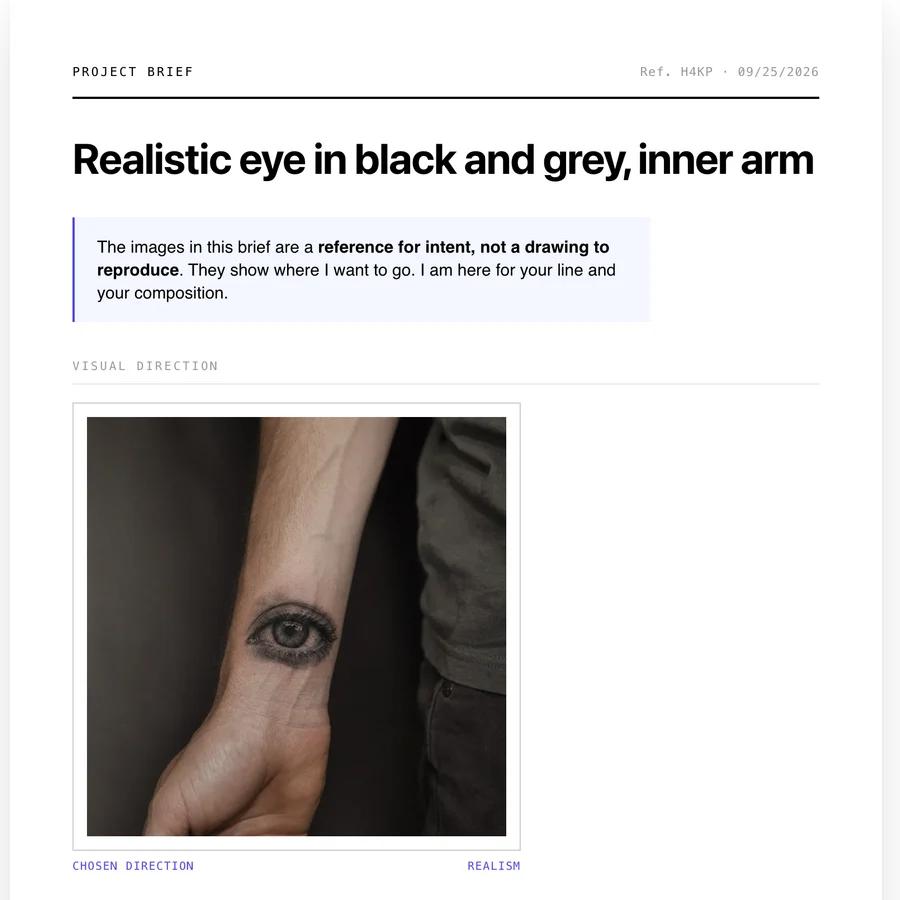 Intent
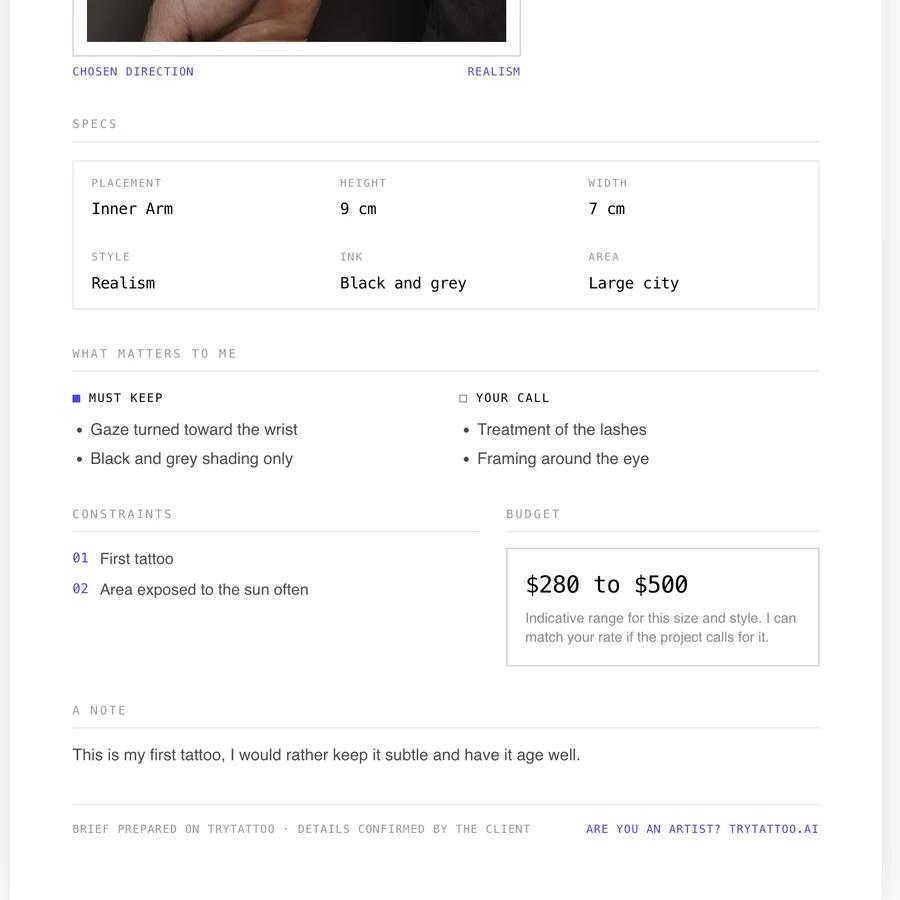 9 x 7 cm
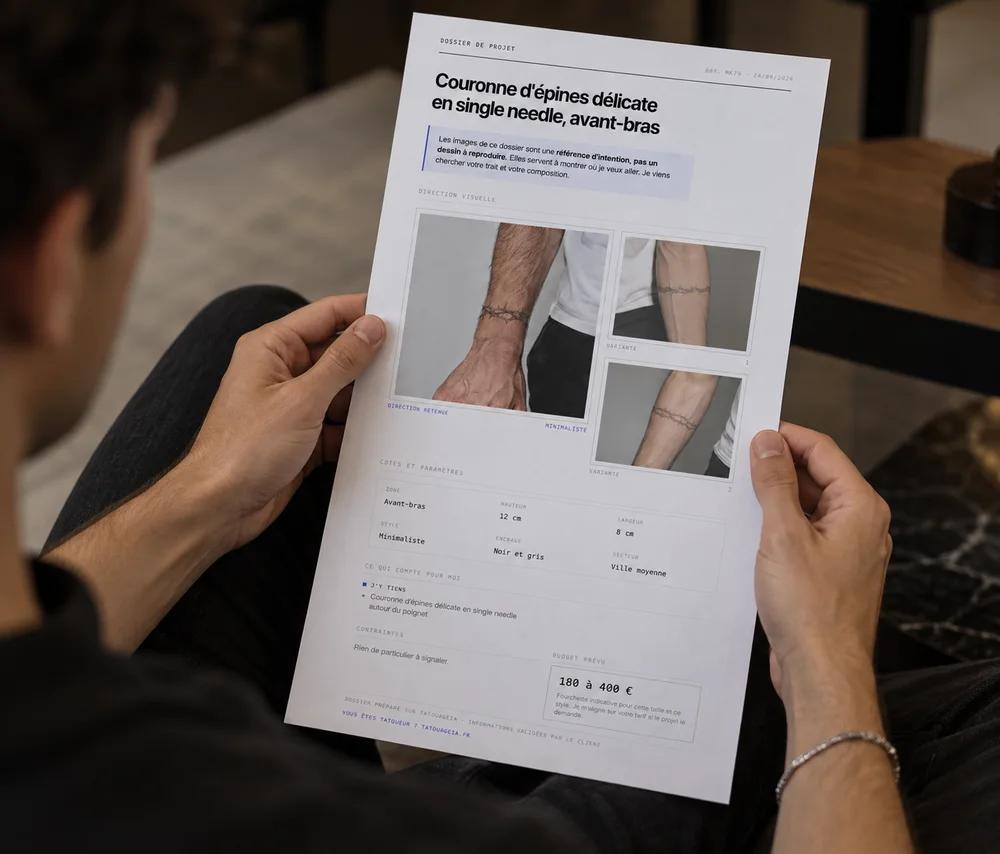 On the table
Brief prepared on TryTattoo
Why walking in with a brief changes the consultation
A tattoo artist spends much of a consultation pulling out information the client already has in mind but has never put into words. Which exact area, what size, colour or black and grey, what budget. Until those answers exist, the artist cannot quote and cannot start drawing, so the appointment often ends with "email me your references", pushing the project back by weeks.
Arriving with those answers written down flips the dynamic. The conversation starts where it gets interesting: composition, exact placement, what will still read well in ten years. You also reclaim artist time that would have gone into back-and-forth messages. It works like a brief in graphic design: the clearer the frame, the more freely the person opposite you can create inside it.
The six things a tattoo artist expects from you
This list covers what studios ask for again and again at consultation. Everything else, the meaning of the design and your story, is for the conversation, it does not need to be on the page.
- 01The placement, as precise as you can: "inner left forearm" rather than "my arm". The area drives the price, the pain and how the piece has to be composed.
- 02The size in centimetres, height and width. Not "medium", not two fingers held apart.
- 03The style: fine line, realism, traditional, dotwork, ornamental. If you are unsure, say so, a good artist will steer you.
- 04One to three visual references, each with what you take from it. An image with no comment leaves the artist guessing whether you like the subject, the linework or the composition.
- 05Your budget, as a range. This is what lets the artist tell you straight away whether the project fits one session or needs splitting.
- 06Your constraints: covering an old tattoo, a scar or mole on the area, reactive skin, a deadline (wedding, trip, summer).
If you only prepare two of them, make it the placement and the size in centimetres. Those are the ones that unlock a quote.
Size in centimetres, the spec almost nobody brings
This is the most common blind spot. A design that is "not too big" can mean 5 cm to you and 15 cm to the artist, and the gap changes everything: price, session length, and above all how much detail can hold. A busy design shrunk to 6 cm will close up over the years, because fine lines thicken and spread slightly as they age. An artist who knows your measurement can tell you honestly that detail has to come out at that scale.
The simplest way to find your size: take a ruler, measure the area on your body, then draw the rectangle with a washable marker or mark it with tape. You will see immediately whether the 12 cm you had in mind covers half your forearm. For what size means for your wallet, our guide on [how much a tattoo costs](/guide/tattoo-cost) breaks down shop minimums and hourly rates.
Separate what you insist on from what you leave to the artist
This is the part artists appreciate most, and almost nobody prepares it. Take your reference and break it into elements: the main subject, the secondary elements, the treatment (shaded, dotted, solid), the composition. For each one, pick a side: must keep, or your call.
A concrete example. On a crown of thorns wrapping the forearm, you can insist on the single needle line and a clean closure of the band, while leaving the artist free to choose the number of thorns, their direction and how the piece resolves on the inner wrist. The result: the artist knows exactly where there is room to propose something better, and that is often where the drawings you would never have asked for come from.
What is better left out of your brief
- Another artist's work with a request to copy it. Showing a peer's piece as a style reference is fine; asking for a replica is not.
- Twenty images. Past three references, the artist reads contradictory signals and has to make the call for you.
- A hard ceiling instead of a range. "$150 max" closes the discussion; "around $150 to $250" opens it.
- Your medical details. Allergies, medication, pregnancy: these are said out loud at the studio on the day, they do not belong on a sheet of paper or in an email.
- A drawing already finalised by someone else. Unless you specifically want your own drawing reproduced, in which case say so upfront.
When to send it: before or during the appointment
If the studio takes enquiries by email or Instagram, attach your brief in the very first message. The artist can then reply with a real opinion instead of a list of questions, and you save a full cycle. Keep a printed copy for the consultation: a sheet on the table can be read by two people, pointed at and annotated, which a phone that locks every thirty seconds cannot.
If the artist suggests changes during the appointment, write them on the sheet and take it with you. It becomes your record of what was agreed, and it spares you the classic "what did we say about the size again?".
The same project, with and without a brief
Two clients walk in with the same crown of thorns idea for the forearm. Here is what separates them.
No brief: the camera roll
Pros
- No preparation, you can book right away
- You stay free to change your mind on the spot
Cons
- The consultation turns into a questionnaire: placement, size, budget, all of it has to be extracted
- The quote gets postponed for lack of information
- Contradictory references push the artist to decide for you
- You often leave with "email me that" and another two weeks gone
With a brief: one page on the table
Pros
- The artist can quote during the appointment
- The conversation starts on composition, not admin
- What you insist on is written down, so it is respected
- You leave with an up-to-date record of what was agreed
Cons
- It takes a few minutes upfront
- A brief that is too rigid can shut out the artist's ideas, which is exactly what the your-call column is for
Build your brief in five minutes
Total time: 5 to 10 minutes
- 01
Lock in your reference design
Start from the design that actually speaks to you. If you do not have one yet, describe your idea to our [tattoo generator](/studio) and keep the one you still want to look at the next day. Add one or two variations you considered without picking: they say as much about your taste as your final choice.
- 02
Set the placement and the size
Pick the precise area, then measure height and width in centimetres on your own body. Decide between black and grey or colour too, that question always comes up.
- 03
Split your reference into must-keep and your-call
List the elements of the design and sort them. Three non negotiables is plenty; everything you leave out becomes creative room for the artist.
- 04
Set your budget range
A realistic range for your size, area and style. Our tool works one out from those parameters, and you can adjust it to what you have actually set aside.
- 05
Flag your constraints, then print
Cover-up, scar, sun exposure, deadline. Generate your page, keep the PDF on your phone and print it to put on the table. [Create my brief now](/editor?brief=1).
See your tattoo before the appointment
Our tool puts your design, your measurements in centimetres, your budget range and your constraints on a single page, ready to print or send to your studio.
Create my tattoo briefFrequently asked questions
01Do I really need to print my brief?
+
Do I really need to print my brief?
It is not mandatory, but a sheet between the two of you can be read together, annotated, and it does not lock after thirty seconds. Send the digital version ahead by email or Instagram, and keep the printout for the consultation.
02Can an artist refuse a project based on an AI-generated image?
+
Can an artist refuse a project based on an AI-generated image?
Yes, some artists decline to work from a generated render on principle, and that is their right. Most are happy to when the image is framed as a reference for intent rather than a drawing to copy. Write that explicitly on your brief and raise it in your first message.
03How many visual references should I bring?
+
How many visual references should I bring?
One main reference and one or two variations. Past three, you send contradictory signals and the artist has to arbitrate for you, which is exactly what you were trying to avoid.
04Is it rude to state my budget first?
+
Is it rude to state my budget first?
No, it is usually welcomed. A range lets the artist tell you immediately whether the project fits one session, needs to be smaller, or should be split. Give a range rather than a hard ceiling, which closes the conversation.
05What if the artist suggests something different from what I prepared?
+
What if the artist suggests something different from what I prepared?
That is a good sign: it means they are taking ownership of the project. Your must-keep column exists precisely to mark what does not move. For everything else, the suggestion comes from someone who knows how a design holds on skin over ten years.
06Does a brief replace the consultation?
+
Does a brief replace the consultation?
No. It makes it shorter and more useful, but nothing replaces the moment the artist looks at your skin, the shape of the area and talks through exact placement with you.
Go further
More guides and inspiration to feed your project.
Author
The TryTattoo team
The studio behind the AI tattoo generator
TryTattoo helps people planning a tattoo project: AI design generation, on-skin preview, price estimation. Our guides rely on public sources, are illustrated with designs created with our own tool, and are reviewed before publishing.
More about TryTattoo →