Tattoo Guide/maori tattoo meaning
What does a Maori tattoo mean?
Hypnotic spirals, aligned triangles, tiki faces: the Maori tattoo is one of the most recognizable in the world, and one of the most loaded with meaning. Here, no motif is chosen at random: every curve **tells a story**, that of a lineage, an ordeal, a place within the group. Before you take the plunge, here is what the main symbols mean, and why the distinction between tā moko and kirituhi deserves your attention.
6 min read · Updated Oct 2026
Koru, hei matau, spirals: describe the symbols that speak to you and generate your Maori-inspired composition.
Create your Maori-inspired tattooQuick answer
A Maori tattoo symbolizes identity, strength, protection and genealogy (whakapapa, the family history). In Māori culture, a tattoo is never purely decorative: every motif tells the story of the person wearing it. The koru (fern frond) evokes renewal, the hei tiki protection, the manaia a spiritual guardian, shark teeth strength. For non-Māori, there is kirituhi, a Maori-inspired tattoo open to everyone.
Key takeaways
- 01The Maori tattoo expresses identity, strength, protection and genealogy (whakapapa)
- 02Tā moko: a sacred tattoo reserved for Māori · kirituhi: Maori-inspired and open to everyone
- 03Koru = renewal · hei tiki = protection · manaia = spiritual guardian · hei matau = prosperity
- 04Each piece reads like a personal story, not a simple ornament
- 05Favorite placements: shoulder, arm, calf, in large pieces that follow the muscle
Maori-inspired tattoos on skin
TryTattoo designsFrom dense blackwork covering the whole shoulder to a minimalist single-line koru: the Maori vocabulary adapts to every wish.
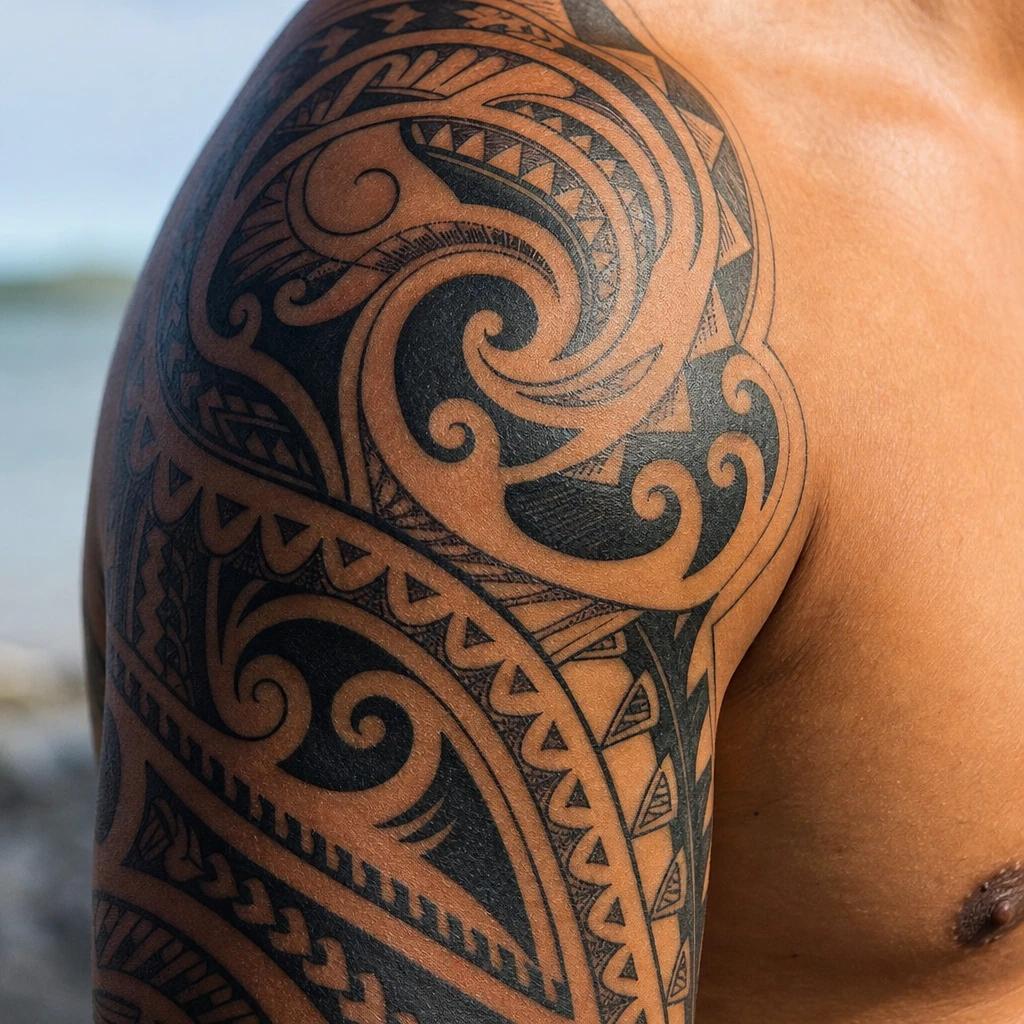 Blackwork
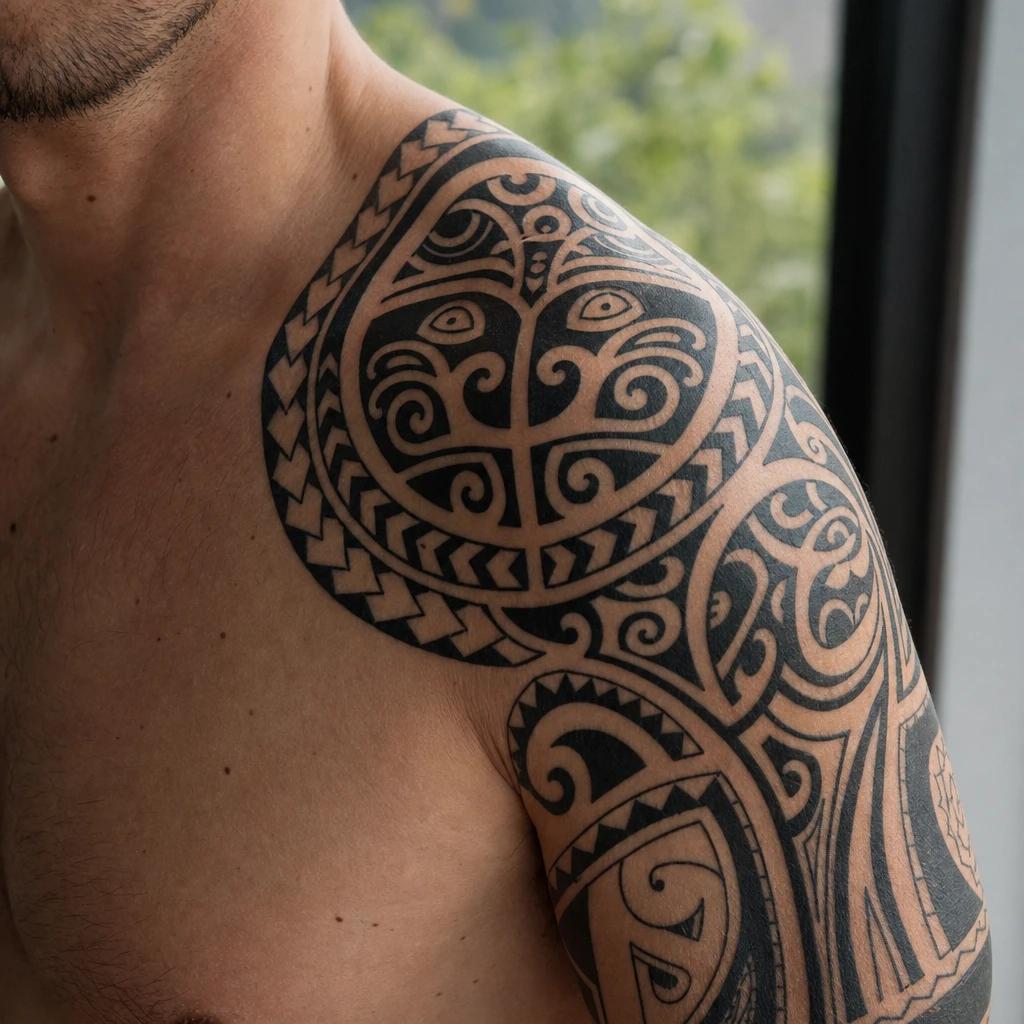 Shoulder
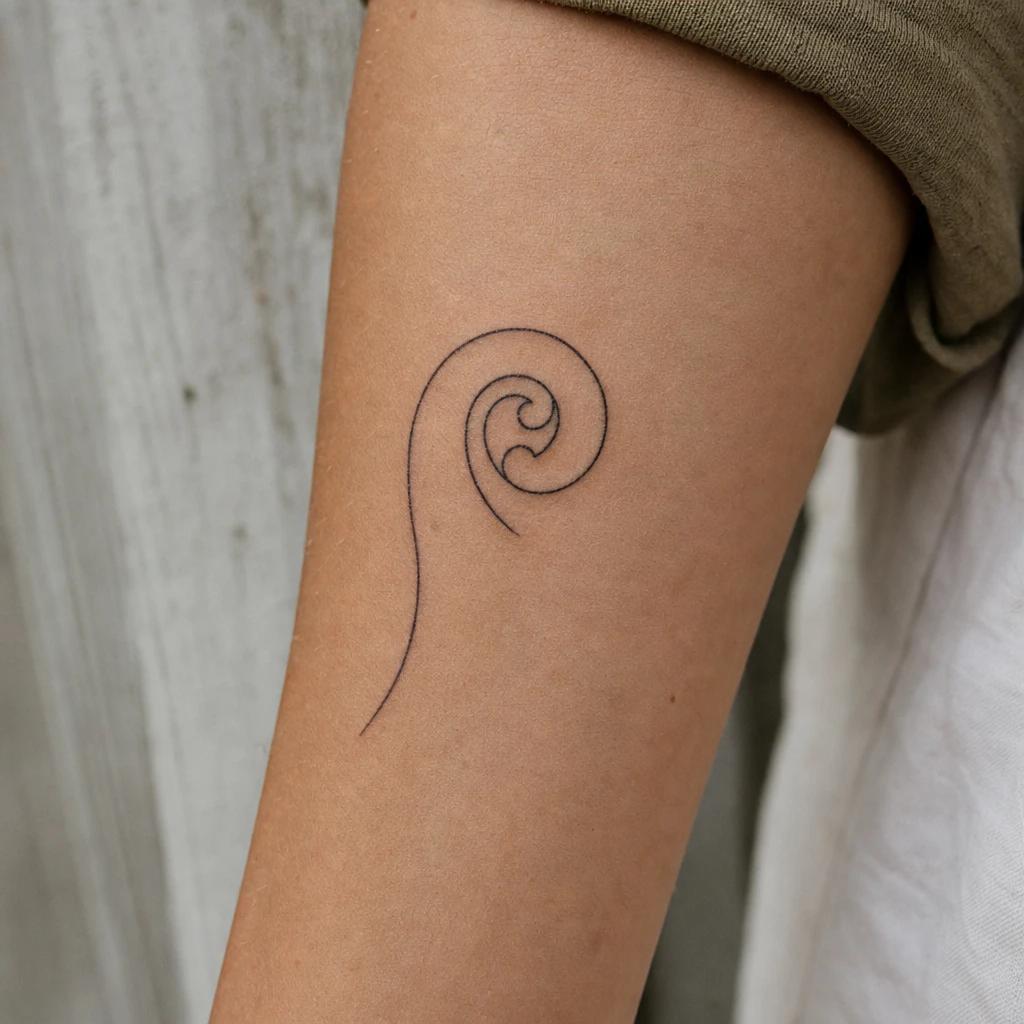 Fine-line
Designs generated with TryTattoo.
Tā moko and kirituhi: what a Maori tattoo tells
In Māori culture, the traditional tattoo is called tā moko. It is not decoration: it is an identity card engraved into the skin, expressing whakapapa (genealogy), rank, achievements and belonging to a community. A moko belongs to the person who wears it and to their lineage. That is why you never copy someone's moko: it would mean appropriating their story.
For people outside Māori culture, there is a dedicated term: kirituhi (literally 'drawn skin'). It is a tattoo that uses the Maori graphic vocabulary (koru, spirals, triangles) but without telling a specific genealogy. It is created to be worn by non-Māori, as a respectful homage to this art rather than the borrowing of an identity. If you want a tattoo in this style, it is the path to choose, ideally with an artist who knows and respects this culture.
Beyond the motifs, the Maori tattoo therefore carries universal values: identity, strength, protection and the bond with the ancestors. To explore other symbols, see our guide to [tattoo meanings](/guide/tattoo-meanings).
The meaning of the main Maori motifs
Each symbol has a precise meaning, and a complete piece often combines several of them to compose a story:
- Koru (fern frond): renewal, growth, a fresh start. Inspired by the young silver fern unfurling, it is the most tattooed Maori motif
- Hei tiki: protection and fertility. This stylized human figure, traditionally worn as a pendant, acts as a talisman passed down from generation to generation
- Manaia: the spiritual guardian. A creature often depicted with a bird's head and a man's body, it watches over its wearer and bridges the world of the living and the world of the spirits
- Hei matau (fish hook): prosperity, abundance and safety on the water. A nod to fishing, a pillar of Māori life, and a good luck charm for travelers
- Niho taniwha (shark or taniwha teeth): strength, courage and protection. These are the rows of triangles you see on almost every large piece
- Pikorua (crossed twist): the eternal bond between two people or two life paths coming together
- Ngaru (waves) and spirals: the ocean, travel, the perpetual movement of life
The history of tā moko in New Zealand
Tā moko arrived in Aotearoa (the Māori name for New Zealand) with the Polynesian ancestors of the Māori people, who developed a unique style there. Traditionally, it was not done with needles but with uhi, bone chisels that carved actual grooves into the skin. The process was long, painful and highly ritualized.
The most sacred moko is the one on the face: the mataora for men, and the moko kauae, worn on the chin by women. It indicated a person's rank, lineage and social status: you could literally read who someone was by looking at their face.
Colonization and cultural pressure pushed the practice back for a long time. Over the past few decades, tā moko has experienced a strong revival in New Zealand, carried by the revitalization of Māori culture: more and more Māori wear it again as an act of pride and identity reclamation. This is also what explains the sensitivity around its use by non-Māori.
Styles and placements for a Maori tattoo
The dominant style is dense blackwork: deep black, large solid areas, alternating spirals and triangles that follow the volume of the muscle. That is why the prime placements are the shoulder (the cap piece flowing down over the deltoid), the arm as a sleeve, the calf and the upper chest. These areas offer natural curves that the motifs come to underline.
There are also more discreet versions: a fine-line koru on the arm, a small spiral on the wrist, a lone hei matau on the forearm. Even in a reduced format, the symbol keeps its meaning.
Worth noting: what is often called a 'Maori tattoo' abroad is frequently Polynesian in the broad sense. Samoan, Marquesan and Tahitian styles share part of the graphic vocabulary, but each culture has its own codes. If the precise origin matters to you, do your research before choosing your motifs. You can [generate your Maori-inspired design](/studio) with TryTattoo to compare several compositions before the appointment. And if identity tattoos speak to you, also check the [viking tattoo meaning](/guide/viking-tattoo-meaning), another tradition where the motif tells who you are.
Estimate the price of your Maori tattoo
Size, placement, region: get an instant price range for your Maori-inspired tattoo. Large solid black shoulder pieces require several sessions, so it pays to plan the budget ahead.
Real examples
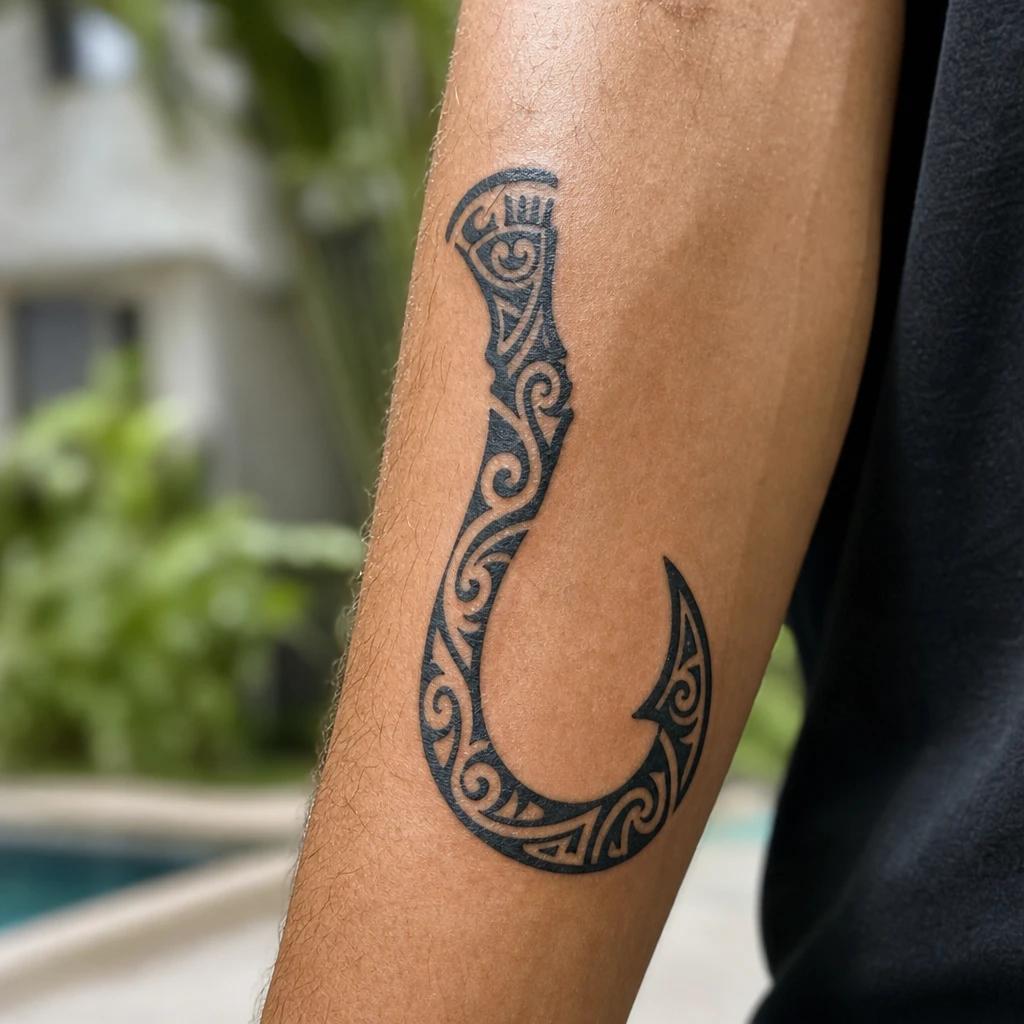
Hei matau on the forearm
Stylized fish hook adorned with koru spirals, tattooed in black on the forearm. A symbol of prosperity, abundance and safe travel on the water, in a discreet format that stands on its own.
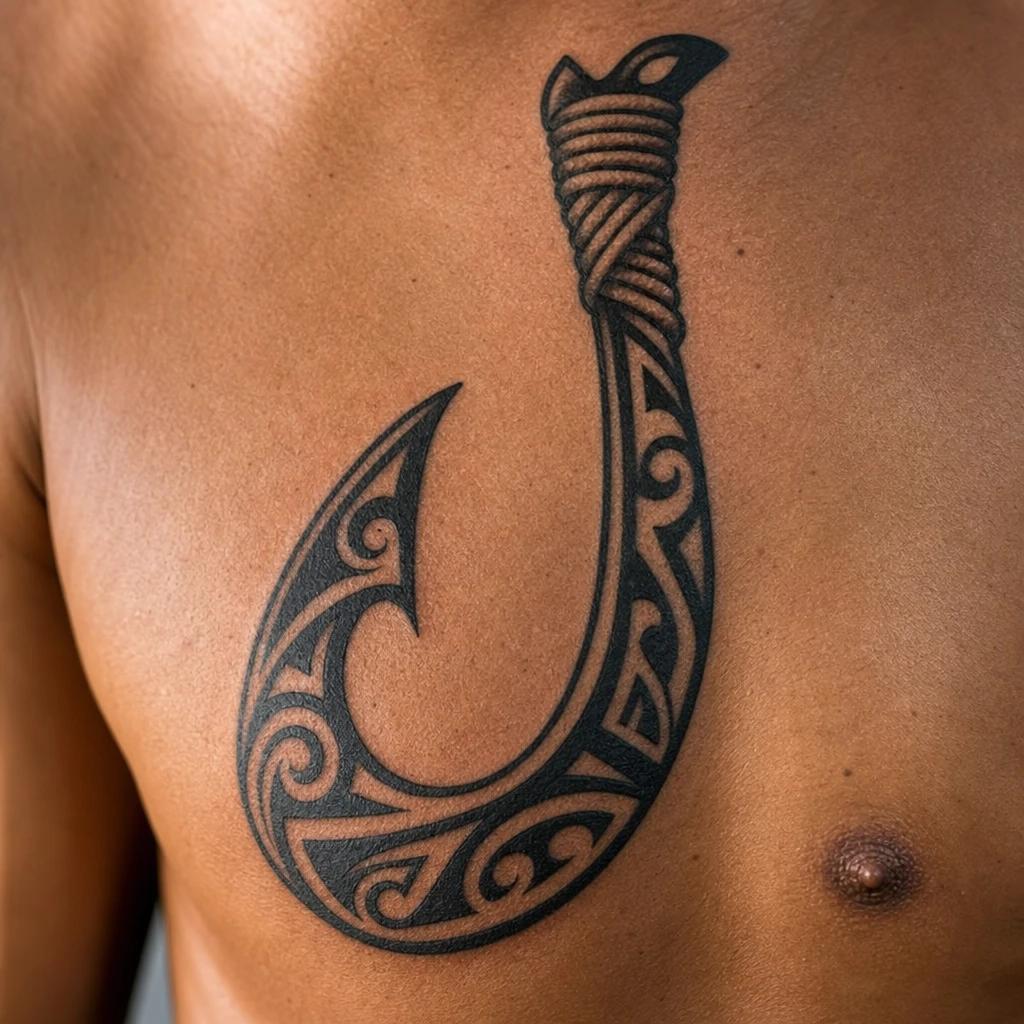
Hei matau on the chest
Chest version of the fish hook, with its braided cord lashing at the top and koru inside the body of the motif. Placed near the heart, it takes on the dimension of a personal talisman.
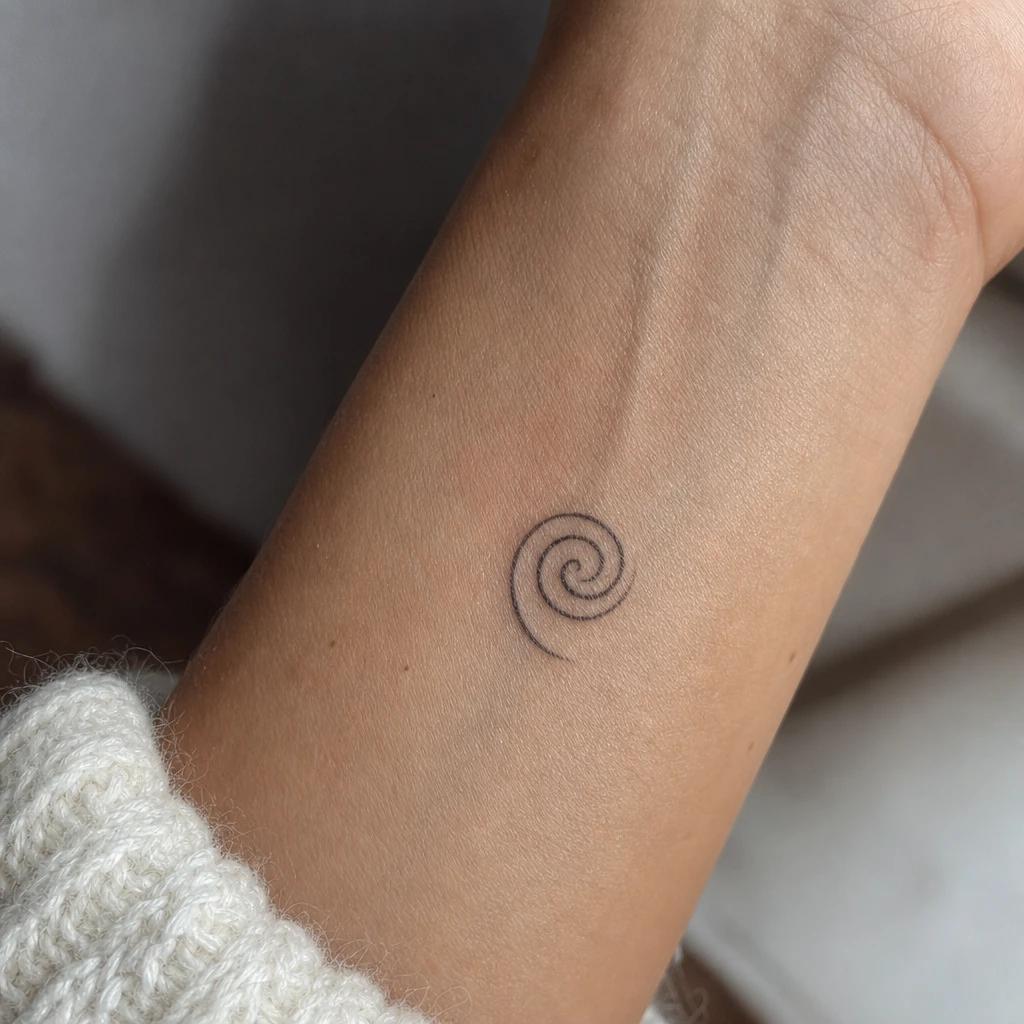
Small spiral on the wrist
Minimalist thin-line spiral on the wrist. The most pared-down version of the koru: a discreet reminder of renewal and growth, visible only to yourself.
See your tattoo before the appointment
Preview your shoulder piece or your fine-line koru on your skin before the appointment with your tattoo artist.
Create your Maori-inspired tattooFrequently asked questions
01Can I wear a Maori tattoo without being Māori?
+
Can I wear a Maori tattoo without being Māori?
Yes, but with an important nuance. **Tā moko** in the strict sense is reserved for Māori, because it encodes a genealogy and an identity that cannot be copied. For everyone else, there is **kirituhi**: a Maori-inspired tattoo created to be worn by non-Māori. That is the respectful approach: never copy a real person's moko, avoid the sacred facial motifs, and if possible work with a tattoo artist who knows this culture.
02What is the difference between a Polynesian and a Maori tattoo?
+
What is the difference between a Polynesian and a Maori tattoo?
Maori is one **Polynesian style among others**. Polynesia gathers several tattoo traditions: Māori (New Zealand), Samoan, Marquesan, Tahitian... They share a common vocabulary (spirals, triangles, solid black areas) but each has its own motifs and codes. The koru and the hei tiki, for example, are typically Māori. Many 'Maori tattoos' seen abroad are actually mixed Polynesian compositions.
03Which Maori motifs carry the strongest meaning?
+
Which Maori motifs carry the strongest meaning?
The **koru** (renewal, fresh start), the **hei tiki** (protection, family talisman), the **manaia** (spiritual guardian), the **hei matau** (prosperity, safe travel) and the **niho taniwha**, the shark teeth that symbolize strength and courage. A large piece often combines several of them: it is the assembly that composes your personal story.
04Where should you place a Maori tattoo?
+
Where should you place a Maori tattoo?
Large pieces go on the **shoulder**, the **arm** (sleeve), the **calf** or the chest: the motifs are designed to follow the curves of the muscle. For a discreet format, a koru or a small spiral sits very well on the forearm or wrist. Avoid cutting a fragment out of a large composition to miniaturize it: better to start from a symbol that works on its own, like the hei matau.
05Does a Maori tattoo hurt?
+
Does a Maori tattoo hurt?
It mostly depends on the placement and the size. The classic areas (shoulder, arm, calf) are fairly tolerable, but large pieces require long sessions, and dense solid black areas put a lot of strain on the skin. The ribs and chest are more sensitive. We break it down area by area in our guide on [tattoo pain](/guide/tattoo-pain).
06Can I visualize my Maori tattoo before going to the tattoo artist?
+
Can I visualize my Maori tattoo before going to the tattoo artist?
Yes. With TryTattoo, you describe the symbols that speak to you (koru, hei matau, spirals...), generate several Maori-inspired compositions and [preview them on your skin](/studio) in the desired spot. It is the best way to validate the size and placement of a shoulder piece before committing, and to arrive at the appointment with a clear base to rework with your tattoo artist.
Go further
More guides and inspiration to feed your project.
Author
The TryTattoo team
The studio behind the AI tattoo generator
TryTattoo helps people planning a tattoo project: AI design generation, on-skin preview, price estimation. Our guides rely on public sources, are illustrated with designs created with our own tool, and are reviewed before publishing.
More about TryTattoo →